
3 Simple Ways to Support Your Child’s Learning at Home
As a teacher for many years, one of the questions I was most regularly asked by parents was: What can I be doing to support my child at home?
Often, the most common approach families took was to repeat school-type tasks at home, practising exam-style questions, revisiting homework repeatedly, and judging success by how many correct answers their child achieved. What always struck me about this was the commitment behind it. Parents were clearly motivated and willing to help their child succeed.
However, this approach was sometimes misguided in terms of its effectiveness. Too often, the correct answer became the main measure of success rather than the learning process itself.
In reality, the most powerful support parents can give their children at home often looks quite different from what many people expect. Based on my experience across many years of teaching, here are three simple but highly effective approaches that parents can begin using straight away.
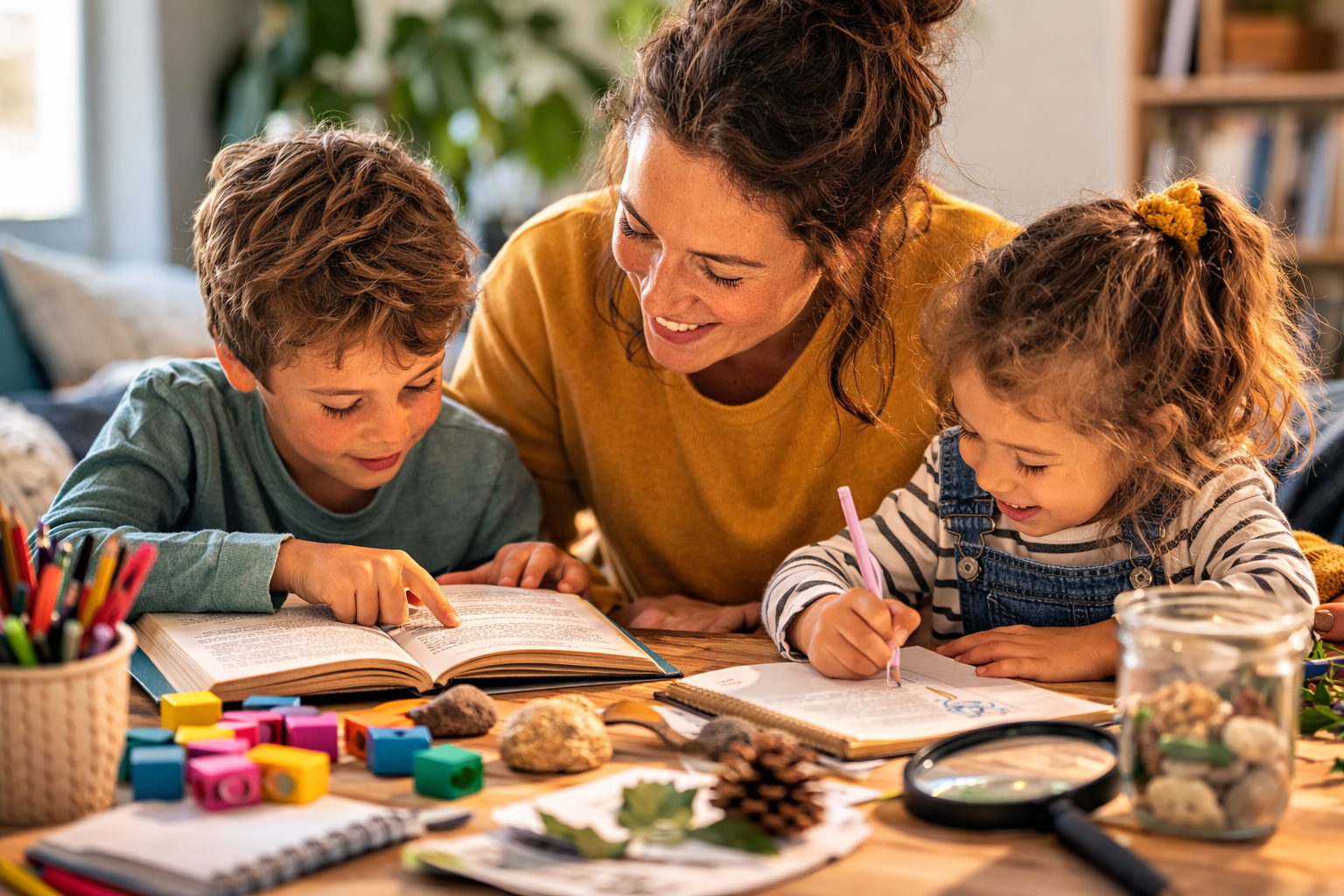
Tip 1: Read Every Day
Reading is one of the most important foundations of learning. It is the primary way we access knowledge, understand new ideas, and communicate effectively with the world around us.
Developing a habit of daily reading is therefore one of the most powerful things a parent can support. Like any habit, reading needs to be practised regularly, supported, and modelled. When children see reading as a normal and valued part of everyday life, they are far more likely to develop confidence and independence as readers.
Research consistently shows that reading has one of the strongest impacts on a child’s cognitive development. It builds vocabulary, strengthens comprehension, and helps children learn how to interpret and think about ideas.
Reading aloud remains particularly valuable, even beyond the early years. While many families read with their children during Key Stage 1, continuing to read aloud together well into Key Stage 2 can have a powerful effect on reading fluency. Listening to fluent reading helps children develop their own sense of rhythm, expression, and understanding of language.
Equally important is the shared experience that reading together creates. It allows time to discuss stories, predict what might happen next, and talk about ideas in the text. These moments deepen understanding and help children see reading as something enjoyable rather than simply something they are required to do.
Over time, these shared experiences play an important role in developing a genuine love of reading: one of the strongest foundations for lifelong learning.
Tip 2: Create Clear and Consistent Routines
School days can be long and tiring, and children often need time to relax when they return home. Long periods of additional work or intensive practice are rarely helpful.
What is often far more effective is establishing short, consistent routines that become part of everyday life.
Regular, repeatable moments of learning, even just a few minutes each day, can have a significant impact on retention of knowledge, development of key skills, and motivation for learning. When learning becomes part of a predictable routine, children are more likely to engage positively and build confidence over time.
For many families this might include small daily practices such as revisiting times tables, having short number conversations, or playing simple maths games together. These moments do not need to feel formal or pressured. In fact, they often work best when they are embedded naturally into family routines.
Play-based learning can also be a powerful driver of progress. Board games, puzzles, and practical activities can all reinforce key skills while maintaining a sense of enjoyment and curiosity.
The goal is not to replicate school at home, but to create a household culture where learning becomes part of everyday life.
Tip 3: Use Real Experiences to Deepen Understanding
Children often understand ideas more easily when they can see and physically interact with them.
Concrete resources, sometimes referred to as manipulatives, allow children to explore relationships and patterns in a way that feels tangible and meaningful. In mathematics this might include counters, number blocks, bead strings, or other objects that help children visualise number relationships.
When children can physically build numbers or represent calculations using objects, they begin to see how numbers connect and interact. This deeper understanding supports their ability to solve problems and reason mathematically, rather than simply memorising procedures.
However, meaningful learning does not need to stay at the table or within the home. Some of the most powerful learning experiences happen when children explore the world around them. Get outside. Go for a walk. Turn over a log. Look closely at what is happening in nature and in the environment around you. Encourage children to notice things, to ask questions, and to wonder about how the world works.
Experiences like these help children connect learning to the world they live in. Each new experience contributes to their developing schema of knowledge. In simple terms, children learn by building new ideas onto what they already understand. The more experiences children have, particularly outside the familiar indoor environments they spend much of their time in, the more reference points they develop. These reference points give new knowledge somewhere meaningful to connect, making learning deeper, richer, and more memorable.
Sometimes parents would like clearer guidance on how best to support their child’s learning. This might be when a child has lost confidence, when progress at school feels uncertain, or when families simply want to make sure they are giving their child the support they need to thrive.
Parents often begin by attending one of our webinars for parents, where we explore practical approaches to supporting learning at home. For more personalised guidance, you can also book a consultation to discuss your child’s learning and identify helpful next steps together.